
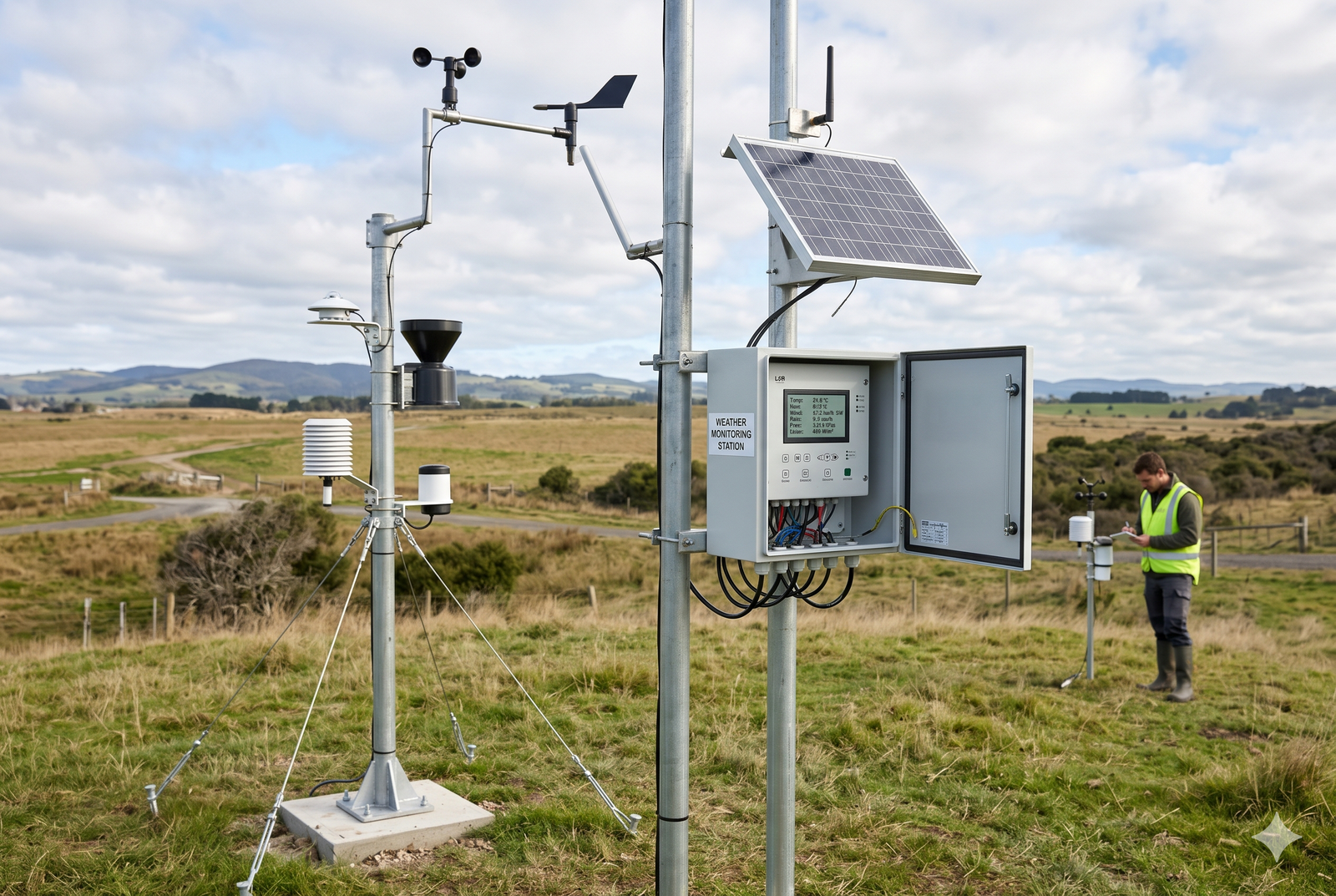
An autonomous industrial weather telemetry station combining multi-sensor meteorological acquisition with dual-mode GSM/Wi-Fi connectivity, delivering real-time microclimate analytics and automated compliance reporting for environmental consultants and regulatory bodies.
The Challenge
Environmental assessment firms, renewable energy developers, and industrial facilities depend on defensible, microclimate meteorological data for dispersion modeling, regulatory EIA compliance, and site-risk forecasting. Commercial weather stations often rely on fragile consumer-grade sensors, lack integrated multi-parameter scaling (such as solar irradiance or tipping-bucket rainfall integration), or fail to bridge remote field locations to centralized databases without manual data retrieval via physical flash drives. When weather stations operate unattended in remote or hostile terrains, network drops and power brownouts frequently cause permanent data blind spots.
What We Built
We engineered an edge-to-cloud automated meteorological telemetry station engineered for continuous, off-grid environmental surveillance. The station’s central telemetry engine samples industrial-grade atmospheric sensors, executing edge linearization, vector averaging for wind parameters, and atmospheric pressure normalization. Equipped with automated fallback between local Wi-Fi networks and multi-band GSM/cellular backhaul, the system streams timestamped weather telemetry directly to environmental databases, supported by onboard non-volatile flash memory to ensure zero data loss during network outages.
Key Capabilities
- Full-Spectrum Meteorological Interfacing: Synchronized acquisition across anemometers (wind speed/direction), tipping-bucket rain gauges, pyranometers (solar radiation), barometric pressure transducers, and precision ambient temperature/relative humidity arrays.
- Edge Vector Averaging & Unit Normalization: Embedded math pipelines computing continuous rolling averages, peak wind gusts, cumulative precipitation indices, and sea-level corrected atmospheric pressure ($hPa$/$mbar$).
- Dual-Band Hybrid Telemetry (GSM & Wi-Fi): Automatic network switching between high-speed plant/campus Wi-Fi and fallback cellular connectivity (2G/4G/NB-IoT) with dynamic sleep-mode optimization for solar/battery-powered stations.
- Fail-Safe Offline Storage: Non-volatile internal memory logging microsecond-tagged raw sensor frames during connectivity loss, automatically synchronizing with cloud servers upon reconnection.
- Environmental Compliance Cloud Integration: Direct REST API, MQTT, and FTP integration for environmental analytics portals, supporting automated generation of wind roses, pollution dispersion profiles, and audit-ready environmental impact reports.
Outcome
Eliminated manual data harvesting trips to remote field sites. Environmental teams receive uninterrupted, microsecond-accurate weather datasets continuously streamed to their operational dashboards, ensuring uncompromised regulatory compliance, reliable environmental impact assessments, and rapid meteorological event detection.