
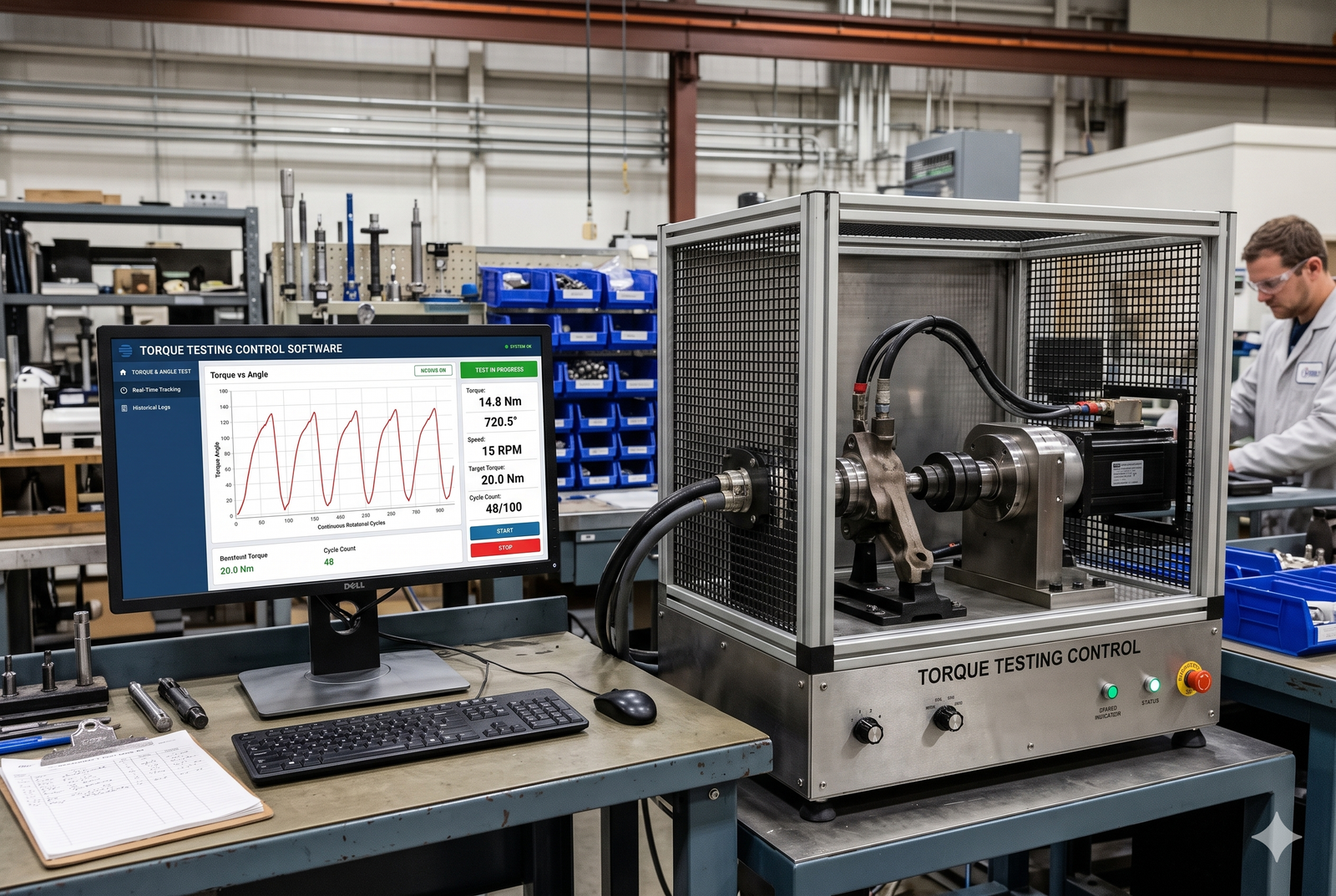
A real-time desktop control and data acquisition suite that executes automated torque-angle cycles, measures dynamic resistance, and verifies rotational performance against critical engineering limits.
The Challenge
Torque-to-turn, break-away torque, and ultimate failure testing require synchronized coordination between drive actuators, angle encoders, and rotary torque transducers. Relying on standalone indicators or manual torque wrenches risks missed peak values, unrecorded slip angles, and inaccurate yield detection. In high-precision components—like gearboxes, valves, fasteners, and steering knuckles—even minor rotational friction anomalies signal manufacturing defects that standard static tests fail to catch.
What We Built
We engineered a specialized desktop control and analytics application designed for rotary test benches and dynamic torque rigs. The software governs servo or stepper motor speed and directional profiles while synchronously sampling torque and angular displacement. As the machine turns, the system overlays torque-versus-angle curves live on the operator console, automatically flagging micro-stalls, binding, and yield points against preset tolerance envelopes.
Key Capabilities
- Dynamic Motion Profiling: Configure speed, angular sweep, rotational limits, multi-step ramping, and bi-directional (CW/CCW) cycles.
- Synchronous Torque-Angle Logging: High-frequency, deterministic sampling capturing instantaneous torque aligned precisely to rotary encoder degrees.
- Signature Characteristic Detection: Real-time algorithmic extraction of break-away torque, running torque, peak values, and gradient transitions.
- Envelope Tolerance Visualizer: Live curve overlays against upper and lower envelope limits, making assembly tight spots and runout immediately apparent.
- Automated Batch Reporting: Zero-touch generation of test certificates complete with torque-angle curves, pass/fail results, and batch statistical summaries.
Outcome
Replaced subjective manual testing with deterministic, repeatable rotational qualification. Manufacturers gain high-resolution visibility into mechanical assembly quality, zero data-entry bottlenecks, and 100% auditable torque records for every produced batch.