
Client: Confidential — Multiple manufacturing facilities, India
Product: Production Intelligence & Monitoring System
Sectors: Glass Manufacturing, Battery Production, General Industrial Manufacturing
Deployment: Edge computing with cloud dashboard, PLC & sensor integration
Across Indian manufacturing, a quiet inefficiency persists at scale. Machines run, products get made, shifts end — and somewhere in between, data that could transform operational decisions gets written on paper, entered into Excel the next morning, or simply lost.
For the manufacturing facilities we worked with — spanning glass production, battery manufacturing, and industrial assembly — the story was familiar. Production supervisors walked the floor with clipboards. Shift handovers relied on verbal briefings. When a machine went down, the alert was someone noticing it had gone quiet. When output targets were missed, the analysis happened after the fact — too late to change anything.
The cost wasn’t always visible on a balance sheet. It lived in the gap between what a facility could produce and what it actually did. In unplanned downtime that stretched longer than it needed to. In shift reports that told you what happened yesterday but nothing about what was happening right now.
These facilities needed intelligence — not more data entry.
The challenge with production monitoring in SME manufacturing isn’t technical — it’s contextual. Every facility is different. Machines from different decades, PLCs from different vendors, floor layouts that evolved organically over years. A system that works for a glass furnace line doesn’t automatically work for a battery cell assembly line.
Our approach was to build a flexible intelligence layer that could sit on top of existing infrastructure without replacing it. No ripping out old machines. No expensive integration projects. No retraining entire workforces on new equipment.
We connected to what was already there — and made it speak.
The system was deployed across production lines ranging from 5 to 20 machines per facility, using a combination of PLC integration and industrial sensors feeding into Raspberry Pi edge computing nodes. Data was processed at the edge before being pushed to a cloud platform — giving facilities real-time visibility without dependence on heavy server infrastructure or expensive cloud compute.
PLC & Sensor Integration Where PLCs were present, we tapped directly into existing control systems to extract real-time machine state data — running, idle, fault, changeover. Where PLCs weren’t available or accessible, we deployed industrial sensors to monitor machine activity, vibration, and output signals. The result was a unified data stream from machines that had never spoken to each other before.
Edge Intelligence with Raspberry Pi Each facility ran a Raspberry Pi-based edge node that handled local data aggregation, preprocessing, and pattern logging. This meant the system remained operational even during internet outages — a critical requirement for manufacturing environments where connectivity can be unreliable. Data synced to the cloud when connectivity was restored, ensuring nothing was lost.
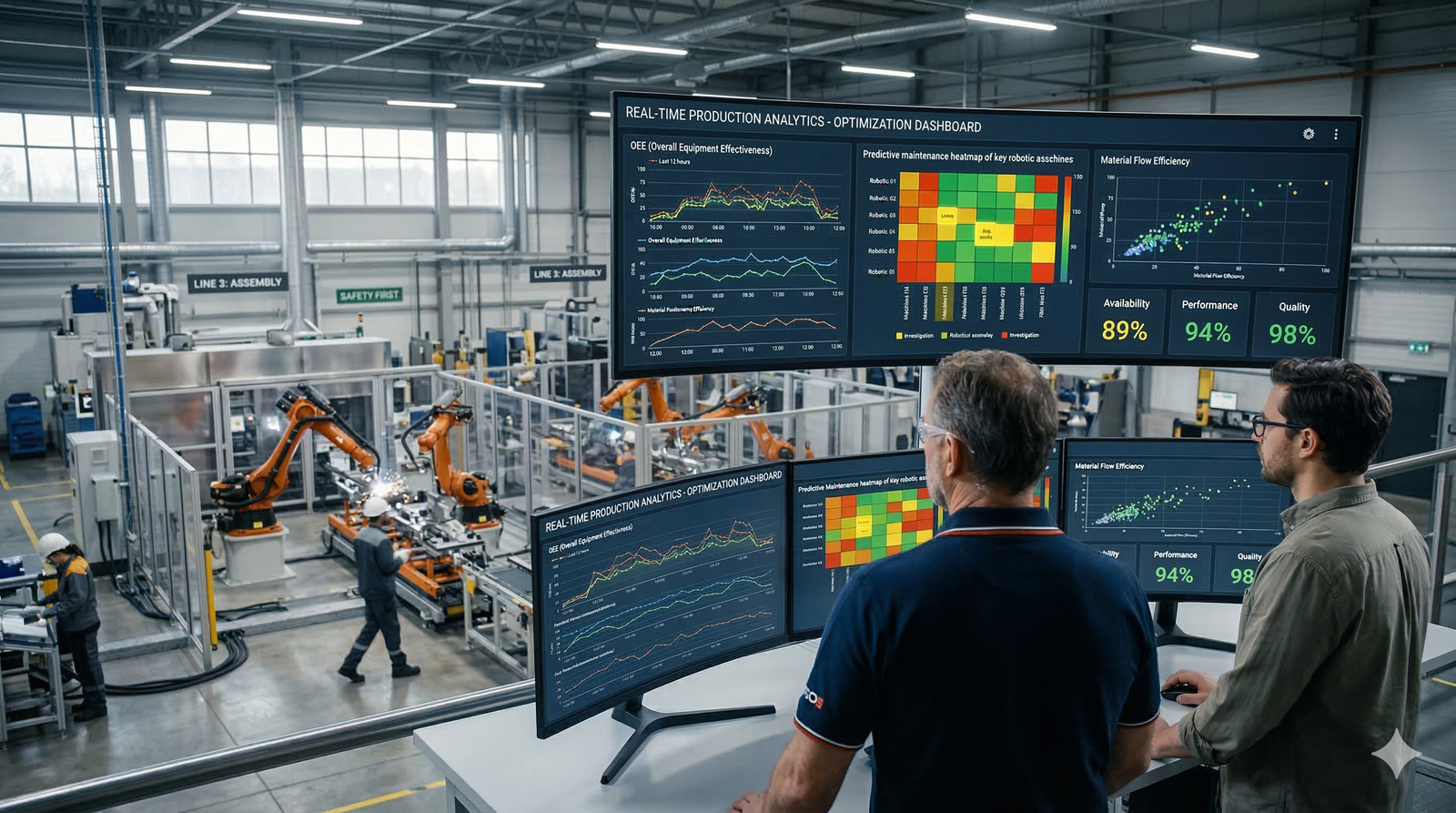
Real-Time Production Dashboard A web and mobile dashboard gave supervisors and management live visibility across all production lines simultaneously. At a glance — which lines were running, which were idle, current output vs shift target, cumulative daily production, and live machine status. For the first time, a factory manager could see the entire floor from a phone screen without walking a single step.
Shift Performance & OEE Tracking The system automatically calculated Overall Equipment Effectiveness — availability, performance, and quality — for each production line and each shift. Shift reports that previously took supervisors 30-45 minutes to compile manually were generated automatically at shift end. Accurate, consistent, and available instantly to anyone with access.
Intelligent Downtime Detection & Pattern Recognition This is where the system moved beyond simple monitoring into genuine operational intelligence. Rather than just logging when a machine stopped, the system analyzed patterns in machine behavior — subtle changes in idle frequency, micro-stoppages that individually seemed insignificant but collectively signaled a developing problem.
When a machine on a battery production line began showing an unusual pattern of brief, repeated stoppages — each too short to trigger a traditional alert — the system flagged it as an anomalous pattern 4 hours before the machine experienced a full unplanned shutdown. Maintenance was alerted early. The intervention took 20 minutes. The alternative, based on historical patterns at the facility, would have been a 6-8 hour production stoppage.
That’s not just monitoring. That’s the beginning of predictive intelligence.
Automated Alerts & Escalation The alert system was tiered by severity and role. Floor supervisors received immediate mobile alerts for machine stoppages and output deviations. Management received shift-level summaries and exception reports. Critical alerts — extended downtime, output falling below threshold — escalated automatically if not acknowledged within a defined window. No alert got lost in a WhatsApp group.
Across deployments, the shift from paper and Excel to real-time production intelligence changed not just how facilities operated — but how they thought about operations.
Downtime response times dropped significantly. Where previously a machine could sit idle for 20-30 minutes before a supervisor noticed and acted, alerts now reached the right person within seconds. The cumulative effect across a shift was meaningful — production facilities reported recovering 45-90 minutes of previously lost production time per day simply from faster downtime response.
Shift reporting went from a manual, error-prone process to an automatic one. Data accuracy improved because the system captured reality directly from machines, not from human memory at the end of a long shift.
But the deeper change was cultural. When supervisors and managers can see what’s happening in real time, decisions improve. Targets become real. Accountability becomes natural rather than confrontational. The factory floor stops being a black box.
Production monitoring is often framed as a tool for large enterprises with sophisticated IT teams and large budgets. The reality is that the facilities that need it most are often the ones least equipped to access it — small and mid-sized manufacturers running on thin margins, older equipment, and manual processes that have persisted simply because there was no affordable alternative.
This system proved that edge intelligence doesn’t require enterprise budgets. A Raspberry Pi, the right sensors, thoughtful software, and a genuine understanding of how manufacturing actually works — that combination is enough to give a factory floor a nervous system it never had.
As AI-driven pattern recognition matures and training data accumulates across deployments, the next evolution is already clear — moving from reactive alerting to genuinely predictive maintenance, giving facilities the ability to see problems coming before they arrive.
Built by Robodeus Labs — intelligence infrastructure for the factory floor.
Every case study starts with a conversation. If your problem is hard and the stakes are real, we want to hear from you.
Start a Conversation